Fall is the season regulars quietly consider the best at Pedernales Falls — and the one first-timers most often get wrong, because “fall” here means three very different months. September is still summer with a calendar date. October is the Hill Country’s sweet spot. And November, when the bald cypress along the river turn copper, is when the park looks like a different place entirely.
Here’s how each stretch actually plays, and how to time a trip to it.
September: Summer’s Last Month
Daytime highs usually stay in the 90s into late September, so the summer playbook still applies — early starts, river by noon, hiking only in the morning. Two things do shift: school’s back in session, so weekday crowds thin dramatically, and the river is often at its lowest after the dry summer. In drought years the upstream gauge reads just a few cubic feet per second in September, which means the falls barely move and the swimming holes shrink.
September also opens the Hill Country’s second storm season. Tropical moisture from the Gulf drives the region’s heaviest fall rains in September and October — which is why this is also a prime flash-flood window (more below).
October: The Sweet Spot
October is what people picture when they picture fall camping here. Highs drift from the 80s into the 70s, nights finally cool into the 50s, humidity drops, and the bugs fade. Every activity opens up at once: the roughly six-mile Wolf Mountain loop becomes a pleasure instead of an endurance test, the swimming area is still warm enough on sunny afternoons, and campsite evenings are the year’s most comfortable.
The catch is that everyone knows it. October weekends book out in the 5-month reservation window nearly as fast as spring, and day-pass capacity gets hit on nice Saturdays. Weekdays stay wide open. Our camping guide and best campsites ranking cover the booking strategy.
November: Cypress Season
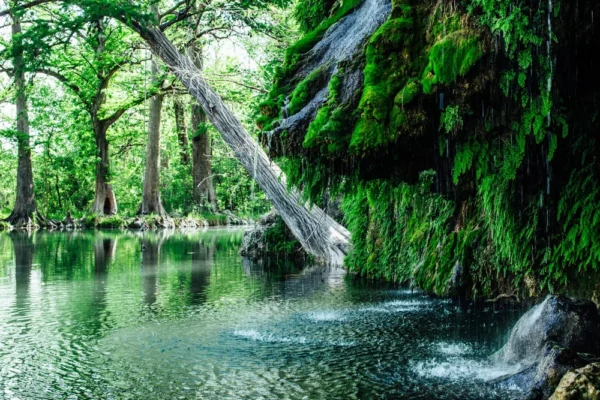
The Hill Country isn’t New England, but the bald cypress that line the Pedernales turn a deep rust-copper, and the pecans, elms, and sycamores in the park’s creek drainages add gold. Along this river, color typically peaks from mid-to-late November — later than most visitors expect, and weather-dependent, so a warm fall can push it toward Thanksgiving. The payoff spots are anywhere the trail meets the river: the half-mile Twin Falls Nature Trail, the swimming-area stretch, and the overlook, where copper cypress frame the limestone steps.
November also delivers the year’s clearest skies. Lower humidity means sharper stars, and with gates closing at 10pm, campers get the best of it — see the stargazing guide. Crowds thin after the first week, and by the week of Thanksgiving the park can feel nearly private.
Fall Flash Floods: The Season’s Serious Caveat
The park’s two most dangerous flood seasons are late spring and early fall. The October 2018 flood pushed the Johnson City gauge to 17.58 feet — one of the highest crests of the past decade — and the July 2026 flood, the river’s highest since 1979, closed every trail in the park. Fall storms arrive on tropical moisture and can dump inches of rain miles upstream while the park sits under blue sky.
The rules don’t change by season: if the river rises, turns muddy, carries debris, or the park’s flood sirens sound, leave the river area immediately. Before any fall trip, check the park’s alert page and the river gauge — our flood guide walks through exactly how.
One upside the park itself points out: catfishing is good after a river rise.
Wildlife in Fall
The golden-cheeked warblers that draw spring birders are gone by the end of June, but fall brings its own traffic: migrating songbirds pass through in September and October, and the park’s overwintering sparrows arrive as temperatures drop. The year-round residents — wild turkeys, roadrunners, rufous-crowned sparrows, scrub jays — are most active in the cool mornings. The bird blind near headquarters is at its best on crisp fall mornings, and white-tailed deer are everywhere at dawn and dusk. The park is also home to armadillos, raccoons, and coyotes you’ll hear more than see.
One scheduling note: Texas state parks hold public hunts in the cooler months, and Pedernales Falls closes entirely during its scheduled hunt dates — from 10pm the night before through 2pm on the final day. The dates vary by year and are posted on the reservation page; confirm them before booking a late-fall weekend.
What to Pack for Fall
Layers are the whole story — a 40-degree swing between a 45°F dawn and an 85°F afternoon is routine in October. Add a light rain shell for storm season, a warmer sleeping bag than summer (the 30–40°F range covers fall nights), and keep the water shoes in the bag: the river’s still swimmable on warm October afternoons. Full list in the packing guide.
A Fall Weekend, Sketched
Friday afternoon arrival, camp set by golden hour, the year’s best campfire weather (assuming no burn ban — check). Saturday: Wolf Mountain loop in the cool morning, lunch at camp, a late-afternoon swim if October’s cooperating, Johnson City dinner (where to eat) — and in late November, the courthouse-square holiday lights, a regional tradition that runs from late November through the holidays. Sunday: sunrise at the overlook for the cypress color, then home. The weekend itinerary has the full version.
Fall rewards the patient visitor. Wait out September, book October early, and don’t miss November — the cypress are worth the trip on their own.
How we research: compiled from official Texas Parks & Wildlife information, NWS and USGS river records, and aggregated visitor reviews. Foliage timing, hunt-closure dates, and burn bans vary by year — verify on the official park page before you drive.
This page contains affiliate links. We earn a small commission at no extra cost to you.